

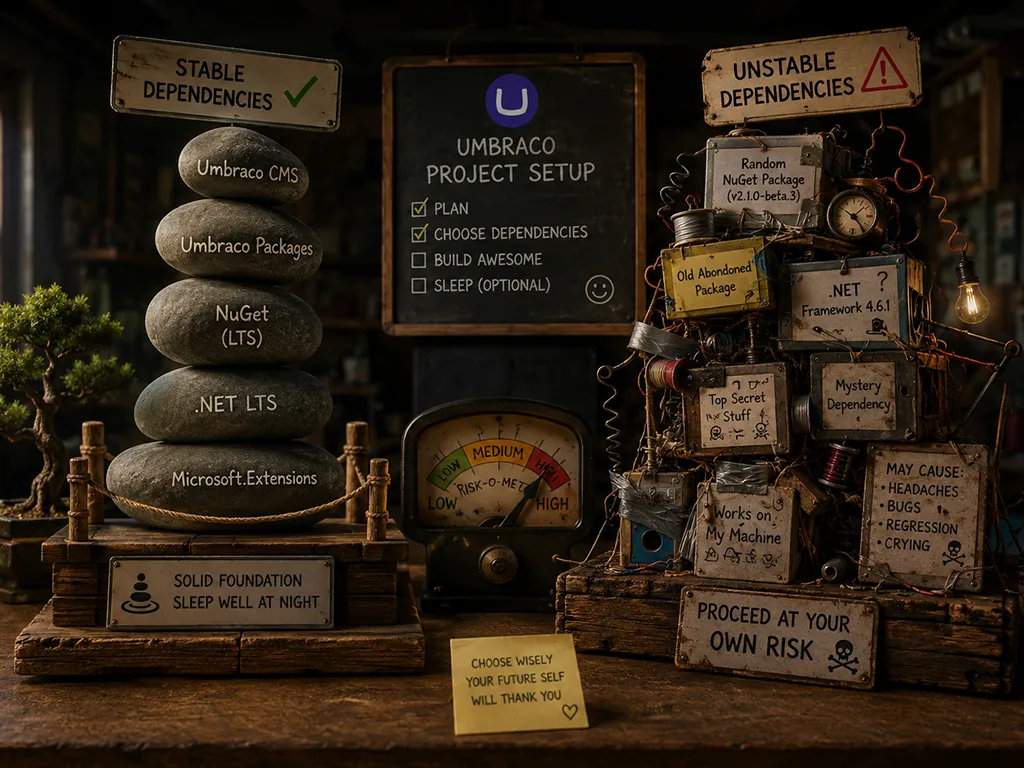
Some Umbraco packages consistently feel worth considering because they reduce recurring development friction, improve maintainability, and solve operational problems more cleanly than custom solutions.
After watching enough Umbraco projects evolve over time, certain patterns start becoming obvious. Some packages quietly become foundational because they solve structural workflow issues repeatedly. Others feel useful initially but gradually become harder to justify as the ecosystem matures.
This is not a definitive “best Umbraco packages” list. It is an opinionated look at a few packages that seem to consistently improve developer experience across many builds, along with one package that arguably became less relevant as modern frontend tooling improved.
At Interon, a South African AI readiness and web development consultancy, we spend a lot of time evaluating technical stacks through the lens of maintainability and operational simplicity. The same principle applies here: dependencies should reduce complexity long-term, not merely postpone it.
Good Packages Solve Recurring Problems, Not Temporary Ones
The most valuable packages tend to remove categories of operational problems instead of fixing isolated inconveniences.
There are a few practical criteria that make a package feel genuinely valuable over time:
- It solves a recurring workflow issue. Packages that only exist to patch one edge case rarely justify becoming permanent dependencies.
- It has a predictable mental model. Developers should not need to constantly revisit documentation just to understand expected behaviour.
- It survives upgrades well. Umbraco evolves quickly, so brittle dependencies become liabilities surprisingly fast.
- It has active maintenance. Abandoned packages create operational risk during production upgrades and deployments.
Those standards eliminate a large percentage of otherwise popular packages immediately.
uSync Still Feels Like One of the Most Sensible Additions
uSync addresses one of Umbraco’s longest-standing architectural frustrations by bringing CMS configuration into source control.
Historically, Umbraco projects have always had an awkward split between:
- Code and templates stored on disk
- CMS configuration stored in the database
That disconnect creates deployment inconsistencies constantly. Developers deploy templates successfully, but document types or data types differ between environments. Editors suddenly encounter validation errors or missing fields that nobody expected.
uSync improves this situation significantly by serialising document types, templates, languages, and other configuration into files that can live alongside application code.
The operational benefits are difficult to ignore:
- Cleaner deployments
- Better CI/CD workflows
- Consistent environments
- Improved rollback confidence
- Reduced manual migration work
For teams managing multiple Umbraco projects, it arguably changes deployment workflows entirely.
There is also a broader engineering principle underneath this. Infrastructure and configuration become more reliable when they are version-controlled and reproducible. uSync pushes Umbraco closer toward that model.
Content synchronisation is where things become more nuanced.
Synchronising actual content nodes across environments can become risky quickly, especially once transactional data, forms, memberships, or commerce functionality enter the picture. In those situations, treating content as deployable infrastructure often introduces more problems than it solves.
Still, for schema management alone, uSync feels difficult to argue against on most modern Umbraco builds.
Konstrukt Solves the “This Doesn’t Belong in Content Nodes” Problem
Konstrukt provides a cleaner way to manage structured operational data inside the Umbraco backoffice.
Almost every mature Umbraco project eventually accumulates data that clearly does not belong in the content tree:
- Applications
- Order records
- Audit logs
- Approval queues
- Custom integrations
- Operational dashboards
Without proper tooling, developers usually end up choosing between bad compromises:
- Force everything into content nodes
- Build entirely separate admin interfaces
- Create fragmented tooling outside Umbraco
Konstrukt offers a much cleaner middle ground by allowing developers to build native-feeling backoffice management interfaces directly in C#.
The appeal is not just speed. It is consistency.
Editors and administrators remain inside the Umbraco environment they already understand. Permissions stay centralised. The interface behaves predictably because it inherits native platform patterns.
From an engineering perspective, this removes a surprisingly large amount of repetitive admin UI work.
It is also one of those packages that highlights an important truth about CMS projects: eventually, most systems become business applications as much as websites.
Konstrukt acknowledges that reality properly.
The licensing cost may deter some teams initially, but comparing it honestly against the cost of building and maintaining custom backoffice tooling often changes the conversation quickly.
Diplo God Mode Quietly Improves Everyday Development Work
Diplo God Mode surfaces operational information that developers repeatedly need during debugging and production support.
On paper, God Mode sounds optional. In practice, it answers questions that appear constantly during real deployments:
- Which .NET version is actually running?
- Did configuration variables deploy correctly?
- What services are registered?
- Which assemblies are loaded?
- Why is one environment behaving differently?
Without visibility tooling, developers often end up relying on:
- Application logs
- Remote server access
- Deployment debugging
- Temporary diagnostic code
God Mode reduces that investigative overhead substantially.
The configuration viewer alone makes a strong case for its usefulness. Seeing runtime configuration values directly inside the backoffice can eliminate a huge amount of deployment guesswork.
That said, packages exposing infrastructure visibility should always be permission-restricted carefully. Operational transparency is valuable for developers but unnecessary for most editorial users.
Good diagnostics tooling improves confidence without increasing security exposure.
The Package That Feels Less Necessary Today: Smidge
Smidge solved a legitimate frontend problem historically, but modern frontend tooling arguably made it far less essential.
For years, Smidge provided a convenient solution for:
- CSS bundling
- JavaScript minification
- Asset fingerprinting
- Runtime frontend optimisation
That mattered because Umbraco itself traditionally stayed relatively unopinionated about frontend build tooling.
The ecosystem changed though.
Modern tooling like Vite dramatically reduced the complexity of proper frontend build pipelines. Even relatively small projects now benefit from build-time asset generation with features like:
- Tree-shaking
- Modern JavaScript support
- Fast development servers
- Improved source maps
- Predictable production outputs
More importantly, frontend tooling increasingly moved toward build-time optimisation rather than runtime optimisation.
That shift makes runtime bundling solutions feel less compelling than they once did.
This does not mean Smidge is “bad.” It simply feels like a package created for an ecosystem problem that modern tooling solved more comprehensively elsewhere.
That distinction matters.
Sometimes dependencies become unnecessary not because they failed, but because the surrounding ecosystem evolved beyond the original problem.
At Interon, we often see older CMS projects carrying years of accumulated dependencies long after the original technical constraints disappeared. Periodically reevaluating tooling is part of keeping systems maintainable.
Frequently Asked Questions
Is uSync still relevant on modern Umbraco versions?
Yes. The underlying deployment and schema-management problems it solves remain highly relevant across modern Umbraco builds.
Do all Umbraco projects need Konstrukt?
No, but projects involving custom operational data or workflows often benefit significantly from it.
Why are developers moving away from runtime bundling tools?
Modern frontend build systems generally produce better optimisation, faster workflows, and more predictable deployment behaviour.
Is Diplo God Mode safe to use in production?
It can be, provided access is restricted appropriately to trusted development users only.
Should older Umbraco projects reevaluate package dependencies regularly?
Absolutely. Dependencies that once solved important problems may become unnecessary as platforms and tooling evolve.
Key Takeaways
- uSync remains one of the most practical ways to improve Umbraco deployment workflows.
- Konstrukt solves operational data-management problems elegantly inside the Umbraco backoffice.
- Diplo God Mode improves debugging and infrastructure visibility significantly.
- Smidge feels less necessary now that frontend tooling ecosystems matured.
- The best dependencies remove recurring operational complexity instead of adding long-term maintenance overhead.
Good technical stacks are not defined by how many dependencies they contain, but by whether those dependencies continue solving real operational problems over time.
If a package consistently reduces friction across multiple builds, it probably deserves its place. If the ecosystem has already evolved past the original problem, removing the dependency may be the cleaner engineering decision.