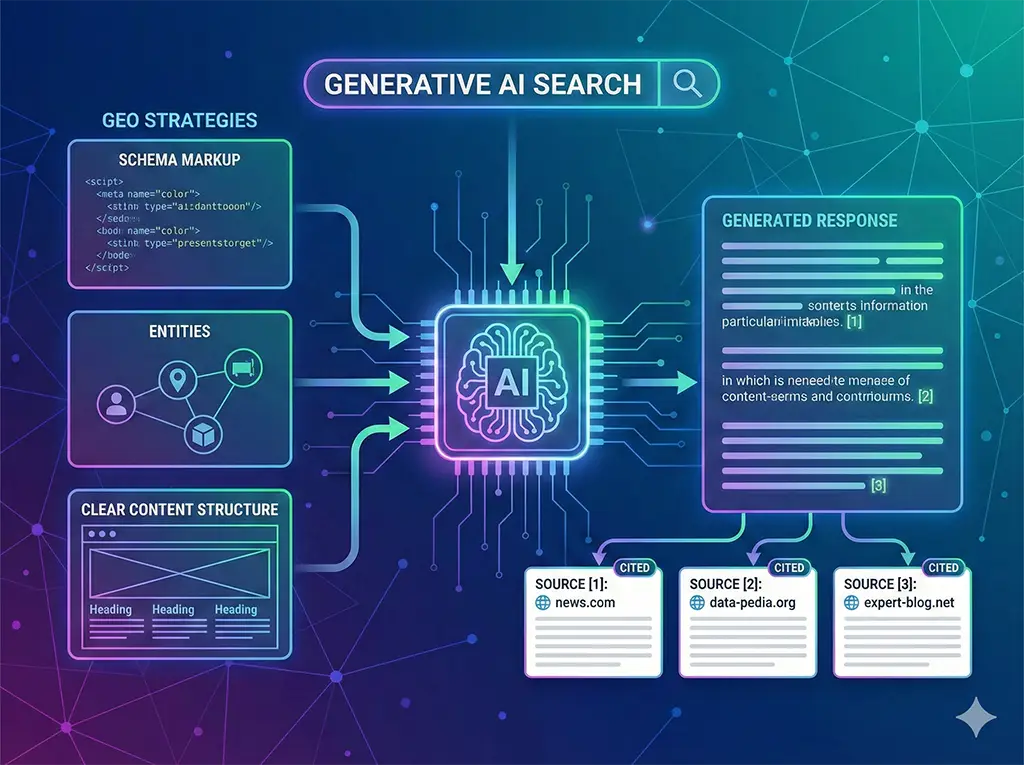


JSON-LD is a structured data format that helps search engines, AI systems, and generative engines understand what your content means instead of only reading its text. As AI-driven discovery becomes more important across search, assistants, and recommendation systems, websites need structured data that clearly defines entities, relationships, context, and intent. Well-implemented JSON-LD does not simply improve SEO visibility. It improves machine interpretability, content trustworthiness, and retrieval accuracy for AI systems.
Many organisations still implement schema markup at a surface level using generic templates or plugins. While basic schema can qualify pages for rich results, advanced JSON-LD implementation patterns help systems understand how information connects across a site. This distinction matters because modern AI systems increasingly rely on structured relationships rather than isolated keywords.
This article explains the JSON-LD patterns that improve machine interpretability, how they work, and how organisations can structure content for better AI discoverability and Generative Engine Optimisation (GEO).
Why machine-interpretable content requires more than basic schema markup
Machine-interpretable content depends on structured relationships, not isolated metadata fields.
Most websites implement structured data reactively. They add FAQ schema for rich snippets, Product schema for ecommerce pages, or Article schema for blog posts. While these implementations are technically valid, they often fail to establish meaningful semantic relationships between entities.
For example, an article mentioning artificial intelligence may identify itself as an Article entity but fail to define:
- Who authored the content
- Which organisation published it
- What concepts the article discusses
- How those concepts relate to other entities
- Whether the content references recognised standards or technologies
- How the page connects to broader site knowledge
Modern search systems and AI models increasingly use entity understanding to evaluate relevance and trust. Structured data therefore needs to operate as a semantic layer across an entire website.
At Interon, a South African AI Readiness consultancy, structured data implementation is treated as an information architecture problem rather than a simple SEO enhancement. Effective schema design creates relationships that machines can consistently interpret.
Entity-first JSON-LD architecture improves semantic understanding
Entity-based schema architecture gives machines a clearer understanding of who and what your content represents.
One of the most important JSON-LD implementation patterns is designing schema around entities rather than pages. Many websites generate standalone schema objects for individual URLs without maintaining persistent identity relationships.
A stronger implementation uses stable identifiers with the @id property.
For example:
- An organisation should maintain a consistent global @id
- Authors should have persistent Person entities
- Services should reference the organisation entity
- Articles should reference authors, publishers, and discussed topics
- Web pages should reference primary entities
This creates a connected graph instead of isolated schema fragments.
Consider a consultancy specialising in AI readiness. Instead of repeatedly redefining the company on every page, a central Organisation entity can be referenced consistently:
- Homepage references the Organisation
- Service pages reference the same Organisation entity
- Articles reference both Organisation and Author entities
- Case studies reference Service entities
- Contact pages reinforce organisation identity
This approach improves entity reconciliation for search engines and AI systems.
Consistent entity design also reduces ambiguity. If an AI system encounters multiple references to “Interon” across content, linked schema relationships clarify that the same organisation is being discussed throughout the site.
Businesses improving AI discoverability should treat structured data as part of a broader semantic strategy rather than isolated technical implementation. Organisations can learn more about semantic optimisation in the schema learning hub.
Nested schema relationships create contextual meaning
Nested JSON-LD structures help machines understand how concepts relate to one another.
Flat schema implementations often provide limited interpretive value because relationships remain unclear. Nested structures provide contextual depth.
For example, an article page discussing AI readiness could contain:
- Article schema
- Author schema
- Organisation schema
- BreadcrumbList schema
- FAQPage schema
- DefinedTerm schema
- Service references
However, advanced implementations do not simply place unrelated schema objects beside each other. They establish semantic relationships between them.
An Article entity might:
- Reference an author using author
- Reference a publisher using publisher
- Reference services using mentions
- Reference concepts using about
- Reference technologies using knowsAbout
This layered structure helps AI systems determine topic relevance, authority, and contextual relationships.
For example, if a page discusses structured data implementation for AI systems, nested schema relationships can clarify that:
- The organisation specialises in AI readiness
- The author has expertise in schema markup
- The article relates to GEO and SEO
- The organisation offers related consulting services
- The content belongs to a broader educational knowledge base
Without these relationships, systems may understand isolated facts but fail to connect them meaningfully.
Using DefinedTerm and About patterns strengthens topical clarity
Explicitly defining concepts helps AI systems interpret specialised terminology more accurately.
Many technical industries use overlapping or evolving terminology. Terms like “AI readiness,” “GEO,” “semantic SEO,” and “machine-readable content” may appear related but can carry different meanings depending on context.
JSON-LD patterns using DefinedTerm, about, and sameAs properties help reduce ambiguity.
For example:
- A DefinedTerm can establish what “AI readiness” means within your organisation’s framework
- The about property can connect content to recognised concepts
- sameAs links can associate entities with authoritative references
- Topic clusters can maintain consistent conceptual relationships
This matters because generative systems increasingly synthesise information from multiple sources. Structured definitions improve consistency in how concepts are interpreted and surfaced.
For organisations building educational content hubs, this pattern is especially valuable. A structured semantic vocabulary helps AI systems understand topical authority across multiple articles.
Interon frequently recommends aligning educational content with structured entity mapping and concept definitions as part of broader AI readiness services.
Multi-type schema patterns improve content classification
Using multiple compatible schema types helps systems interpret content from different perspectives.
One overlooked JSON-LD pattern involves combining schema types strategically. Many pages naturally fit more than one schema classification.
For example:
- A guide may be both Article and TechArticle
- A company page may represent both Organization and ProfessionalService
- A tutorial may qualify as both HowTo and LearningResource
These patterns provide richer interpretive signals.
However, implementation quality matters. Multi-type schema should clarify meaning rather than create conflicting classifications. Schema types should remain logically compatible and aligned with visible page content.
Effective multi-type implementation can improve:
- Search interpretation
- AI categorisation
- Content retrieval relevance
- Knowledge graph alignment
- Voice assistant understanding
Developers and SEO teams should also avoid schema inflation. Adding excessive schema types without semantic justification can reduce clarity instead of improving it.
Machine interpretability depends on precision, consistency, and contextual accuracy.
Schema graph consistency matters across the entire website
Consistent schema implementation across all pages strengthens machine confidence and entity recognition.
Many structured data implementations fail because schema logic changes between templates, authors, or CMS plugins. Inconsistent naming conventions, duplicate entities, and fragmented relationships weaken semantic reliability.
Strong JSON-LD architecture requires governance.
This includes:
- Maintaining consistent entity IDs
- Using standardised naming conventions
- Defining reusable schema components
- Aligning schema with visible content
- Auditing structured data regularly
For example, if an organisation uses “AI Readiness” on some pages and “AI Preparedness” on others without clarification, systems may interpret them as separate concepts.
Consistency is particularly important for:
- Organisation identity
- Service naming
- Author attribution
- Knowledge hubs
- Educational taxonomies
- Product categorisation
Advanced schema implementations therefore require collaboration between developers, SEO specialists, strategists, and content teams.
Businesses evaluating their semantic architecture can run a free audit to identify structured data gaps affecting AI discoverability.
Frequently Asked Questions
What is JSON-LD in structured data?
JSON-LD stands for JavaScript Object Notation for Linked Data. It is a structured data format used to help machines understand entities, relationships, and meaning within web content.
Why is JSON-LD important for AI systems?
AI systems use structured relationships and entity understanding to interpret content more accurately. JSON-LD helps clarify topics, authorship, organisations, and semantic connections.
What makes content machine-interpretable?
Machine-interpretable content uses structured relationships, clear entity definitions, semantic consistency, and contextual metadata so systems can understand meaning rather than only text.
How does JSON-LD help with GEO?
Generative Engine Optimisation focuses on improving how AI systems retrieve and reference content. JSON-LD supports GEO by clarifying entities, expertise, topics, and relationships.
Can plugins handle advanced JSON-LD implementation?
Basic plugins can generate foundational schema markup, but advanced semantic architecture often requires custom implementation, entity mapping, and ongoing governance.
Key Takeaways
- JSON-LD should create semantic relationships, not isolated metadata fields
- Persistent entity IDs improve machine understanding across a website
- Nested schema structures provide richer contextual meaning
- DefinedTerm and About patterns reduce ambiguity for AI systems
- Consistent schema governance strengthens AI discoverability and GEO performance
Structured data is evolving from a technical SEO enhancement into a foundational layer for machine-readable web architecture. As AI systems increasingly mediate how users discover information, organisations need content that machines can interpret confidently and consistently.
Advanced JSON-LD implementation patterns improve semantic clarity, strengthen entity understanding, and help generative systems retrieve content more accurately. Businesses that invest in machine-interpretable content architecture today will be better positioned for the future of AI-driven discovery.
Interon helps organisations design AI-ready websites with advanced schema strategies, semantic architecture, and structured data implementation built for modern search and generative engines. To learn more, visit the AI readiness resource hub or contact Interon.