
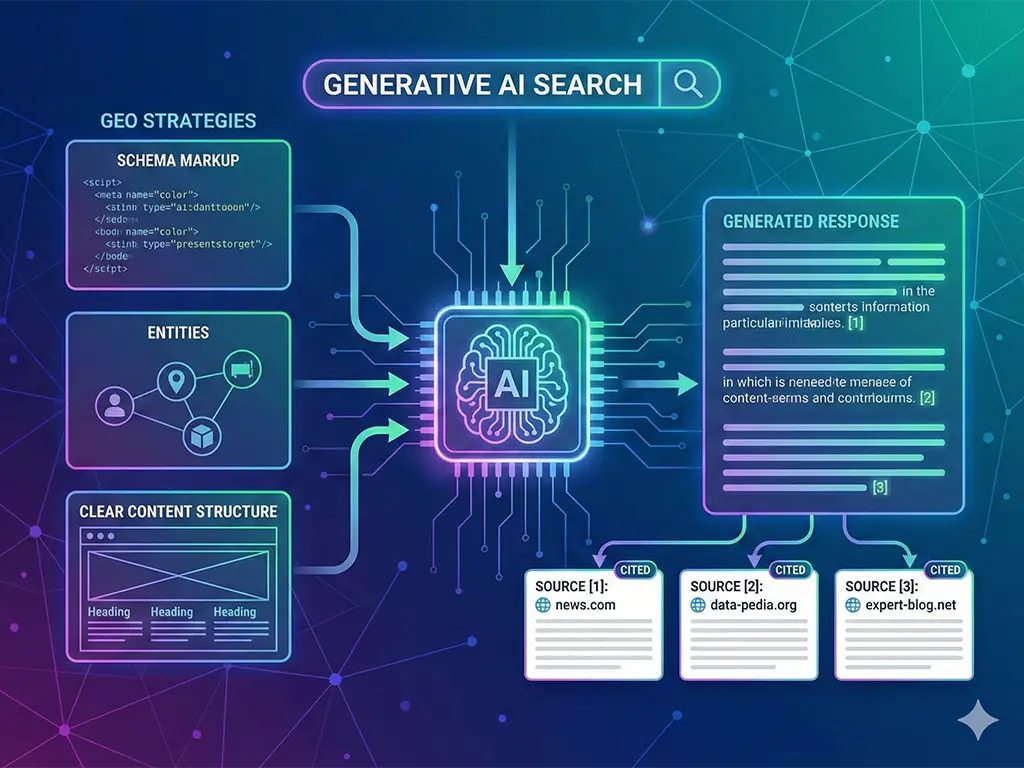
How to Use GEO Effectively: Win Visibility in AI Search
A practical GEO guide to help your content get cited in AI answers, with clear structure, schema,...
February 5, 2026
Generative Engine Optimisation — the practice of structuring your content so AI systems can find, understand and cite your business in generated answers. The businesses that adopt it now will have a significant head start.
Check Your GEO Score — FreeSEO helps search engines find and rank your pages in traditional search results.
SEO asks: "Can Google find and rank my page?"
SEO optimises for links and rankings — appearing in a list of search results.
GEO helps AI systems extract your information and include it in generated responses.
GEO asks: "Can ChatGPT cite my business when someone asks a relevant question?"
GEO optimises for extraction and citation — being the business AI systems reference in their answers.
They're complementary — you need both. SEO drives search traffic. GEO drives AI recommendations.
AI systems generate answers by processing content from across the web. When they encounter well-structured, clearly written content, they're more likely to use it.
Direct, Extractable Statements
Write content that directly answers questions. State facts clearly and concisely instead of burying information in marketing copy.
Bad: "Our innovative solutions leverage cutting-edge technology."
Good: "Interon offers three services: Free Audit, Schema Implementation (from R2,500) and Full Optimisation (from R7,500)."
Question & Answer Pairs
Create FAQ sections that address common questions about your industry and services. AI systems actively look for Q&A pairs because they map directly to user queries. Add FAQPage schema for maximum impact.
Specific, Authoritative Facts
AI systems prefer clear, authoritative claims over vague suggestions. Include specific facts: prices, timelines, locations, qualifications and measurable outcomes.
Comprehensive Coverage
Cover topics comprehensively. Don't just have a services page — have educational content about your industry. This builds topical authority that AI systems recognise.
Schema Markup
Schema markup is one of the most powerful GEO tools. It provides machine-readable facts that AI systems can extract with high confidence. Organization, Service, Product and FAQ schema all contribute.
Clear Business Identity
Make it unmistakably clear who you are, what you do and where you operate. State your business name, industry, location and key services prominently on every page.
5–10 common questions with direct answers on your key service pages.
Prices, timelines, locations — not vague claims and marketing jargon.
Business name, location and industry on every page — not just the homepage.
Organisation, Service and FAQ schema markup for your most important pages.
GEO is harder to measure than SEO because you can't easily track when AI systems cite your content. However, there are useful indicators:
The audit analyses your content structure, FAQ signals, schema markup and answer-friendliness — all key GEO factors.
Run Your Free Audit Now